
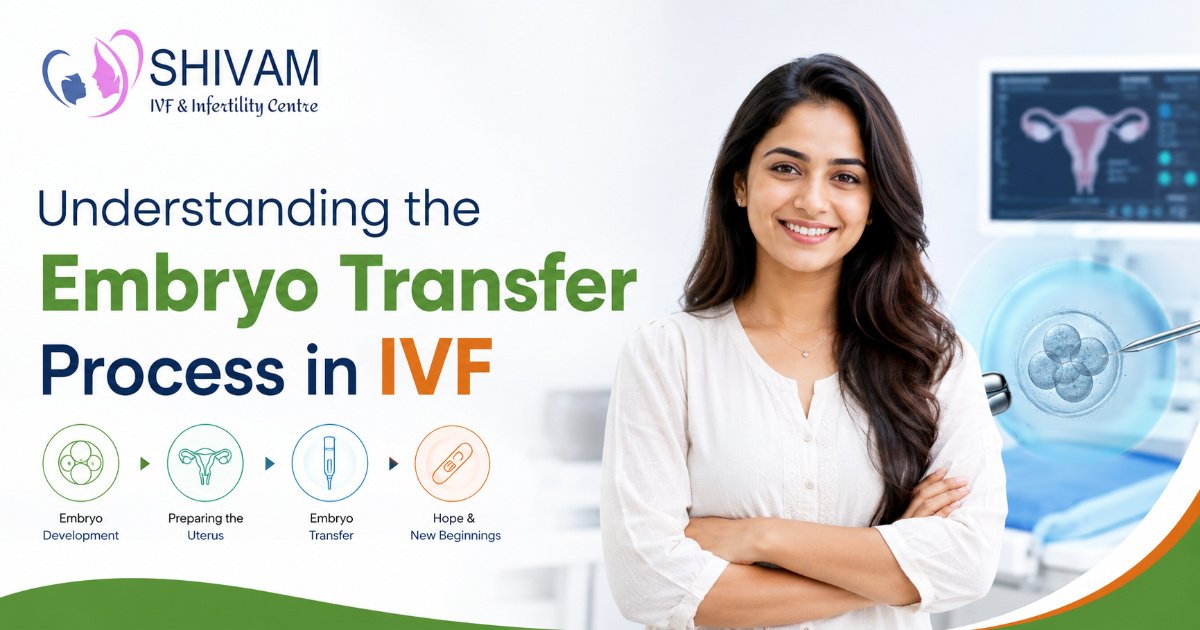
For many couples, IVF feels like a long road.
Appointments. Tests. Medications.
And then comes a moment that carries an extraordinary amount of hope—the embryo transfer.
It's a surprisingly simple procedure. No major surgery. No hospital stay. Yet despite its simplicity, embryo transfer remains one of the most emotionally charged stages of the IVF journey because this is the point where science and possibility finally meet.
At Shivam IVF, patients often arrive on transfer day carrying a mixture of excitement, nervousness, anticipation, and a hundred unanswered questions. That's perfectly normal. After all, when you've invested months—or sometimes years—into building a family, every step feels significant.
So what exactly happens during an embryo transfer? More importantly, what should you expect before, during, and after the procedure?
Let's break it down.
What Is Embryo Transfer in IVF?
Embryo transfer is the stage where a carefully selected embryo is placed inside the woman's uterus to achieve implantation and pregnancy.
Sounds straightforward.
Because medically, it is.
But here's the thing: reaching this stage requires several important steps beforehand. Eggs are retrieved from the ovaries. They are fertilized in a laboratory. The resulting embryos are monitored closely by fertility specialists and embryologists who assess their growth and development over several days.
Only after this process is complete does the embryo transfer take place.
Think of it like planting a seed. The seed matters. The soil matters. The weather matters. Every factor plays a role, and while doctors can optimize conditions, nature still has its own timetable.
Preparing for the Transfer
Many patients imagine embryo transfer as a dramatic procedure.
Not a chance.
In reality, preparation often begins days before the actual transfer. The uterine lining is carefully monitored because it needs to be receptive to implantation. Hormonal medications may be prescribed to support this environment.
At Shivam IVF, every treatment plan is personalised because no two fertility journeys look exactly alike. A lining thickness that works beautifully for one patient may not be ideal for another.
Which brings us to an important point.
Success in IVF isn't about rushing.
It's about timing.
The embryo and the uterus need to be synchronised, almost like two dancers meeting at exactly the right beat in a song. Miss the timing, and the opportunity may not be optimal.
What Happens During the Embryo Transfer Procedure?
The actual procedure is usually completed within minutes.
Yes. Minutes.
Patients are often surprised by how quick and gentle the process feels.
During the transfer, the selected embryo is loaded into a thin, flexible catheter. Guided by ultrasound imaging, the fertility specialist carefully passes the catheter through the cervix and places the embryo inside the uterus.
That's it.
No stitches.
No incisions.
No operating theatre drama.
Many women compare the sensation to a routine gynaecological examination. Some feel mild pressure. Others feel almost nothing at all.
The fascinating part is watching the embryo placement on the ultrasound screen—a tiny moment that carries enormous emotional weight because, although the embryo itself may be microscopic, the dreams attached to it certainly aren't.
Why Embryo Quality Matters
People often focus entirely on the transfer procedure.
Fair enough.
But embryo quality plays a major role in IVF outcomes.
Embryologists spend days observing how embryos divide and develop. They assess factors such as cell structure, growth patterns, and developmental milestones before selecting embryos for transfer.
Imagine choosing a player for a championship final. You wouldn't pick someone randomly. You'd evaluate performance, consistency, and potential.
Embryo selection works in a somewhat similar way.
At Shivam IVF, advanced laboratory protocols help specialists identify embryos with the highest developmental potential, allowing patients to move forward with greater confidence.
The Waiting Period After Transfer
Now comes the difficult part.
Waiting.
Anyone who has undergone IVF will tell you that the days following embryo transfer can feel unusually long. Suddenly, every sensation becomes a mystery.
Was that cramp significant?
Does fatigue mean anything?
Should I be worried?
Should I be hopeful?
The truth is that many symptoms after transfer can be caused by hormonal medications rather than pregnancy itself. Some women experience bloating. Others notice mild spotting. Some experience nothing at all.
Every experience is different.
And that's what makes this phase so emotionally challenging.
The pregnancy test is usually scheduled around 10 to 14 days after transfer, depending on the treatment protocol. Until then, patience becomes part of the treatment.
Easier said than done, of course.
Common Myths About Embryo Transfer
Let's clear up a few misconceptions.
One persistent myth is that complete bed rest improves success rates.
Research doesn't support that idea.
Most fertility specialists encourage patients to resume normal daily activities while avoiding excessive physical strain. Walking around your home isn't going to dislodge an embryo. It isn't balancing on the edge waiting to fall out.
Another myth is that every transferred embryo automatically results in pregnancy.
If only it were that simple.
Successful implantation depends on numerous biological factors, many of which remain beyond human control even with today's advanced reproductive technology.
That's why working with the Best Fertility Specialist in Delhi becomes so important. Expertise helps maximise opportunities, minimise avoidable risks, and provide guidance when uncertainty arises.
Emotional Support Matters Too
IVF is often discussed through statistics, protocols, and medical terminology.
Numbers matter.
Science matters.
But emotions matter too.
Couples frequently describe embryo transfer day as one of the most memorable moments of their fertility journey. Not because the procedure is physically demanding, but because it represents possibility.
Hope enters the room.
Sometimes quietly.
Sometimes overwhelmingly.
A supportive fertility team understands this reality. They recognise that patients aren't just transferring embryos. They're carrying years of expectations, conversations, disappointments, and dreams.
Choosing the Right IVF Centre
The embryo transfer procedure may take only a few minutes, but the expertise behind it is built on years of training, laboratory precision, and clinical experience.
At Shivam IVF, patients benefit from comprehensive fertility care, personalised treatment planning, advanced reproductive technologies, and compassionate support throughout every stage of their journey.
Whether you're beginning IVF for the first time or exploring fertility options after previous challenges, choosing the Best Fertility Specialist in Delhi can make a meaningful difference in both your experience and your confidence.
Because while embryo transfer is a medical procedure, its purpose is deeply human.
A tiny embryo.
A quiet room.
A few careful minutes.
And sometimes, the beginning of a completely new chapter.